
Fredericksburg Area Rentals Property Management Guide

Fredericksburg area rentals property management covers the full range of services, from tenant or guest screening to pricing strategy, that owners hire out to protect and grow income from a Hill Country property. As of 2026, Fredericksburg, TX carries 3,338 active short-term rental listings generating an average of $36,200 in annual revenue per property, according to AirDNA's 2026 market data. At Stay In The Heart of Texas, we work with owners across Fredericksburg and the surrounding Hill Country who are deciding whether to keep running their rental solo or bring in a professional team, and the right answer depends on specifics most articles skip.
Fredericksburg STRs average 39% annual occupancy with an average daily rate of $334 and RevPAR of $135 in 2026, per AirDNA.
Most vacation property managers in the Fredericksburg area charge 20 to 35% of gross bookings for full-service short-term rental management, compared to 8 to 10% typical for long-term residential leasing.
March is peak season, with occupancy reaching 51% and average daily rates near $324, driven by wildflower season and Wine Road 290 traffic.
Fredericksburg visitor spending hit $175 million in 2026, generating $17 million in county tax revenue, according to the Fredericksburg Convention and Visitor Bureau.
STR supply grew 6.9% year-over-year as of mid-2026, meaning listings that skip professional pricing and listing optimization risk losing ground to newer, better-managed competitors.
Fredericksburg requires a valid city business license, STR ordinance registration, and collection of Gillespie County hotel occupancy tax, currently around 8.5%.
If you own a cabin, cottage, or converted barn anywhere between Main Street and the wine country loop, you already know the market has changed since 2026. New listings keep arriving, guests compare more properties before booking, and pricing mistakes cost real money during high-demand weekends. This guide walks through what property management actually includes in the Fredericksburg area, what it costs, when self-managing still makes sense, and the specific compliance and revenue gaps that most owner guides never address.
You'll get a realistic cost comparison between self-managing and hiring out, a breakdown of what "full-service" actually covers versus lease-only or co-hosting arrangements, and a look at how Fredericksburg's short-term rental rules differ from long-term residential management. This isn't a marketing page dressed up as an article. It's the same framework we use internally at Stay In The Heart of Texas when a new owner asks whether management is worth it for their specific property.
What Is Fredericksburg Area Rentals Property Management?
Fredericksburg area rentals property management is the professional oversight of a residential or short-term rental property, covering guest or tenant communication, pricing, maintenance coordination, and compliance with local ordinances. It applies to single-family homes, cabins, condos, and cottages throughout Fredericksburg city limits and the surrounding Gillespie County countryside.
Two distinct models exist in this market. Long-term residential management, the kind handled by firms like Wilkinson Property Management or LORAC Property Management, focuses on year-long leases, tenant screening, and monthly rent collection. Short-term rental management, which is Stay In The Heart of Texas's specialty, focuses on nightly bookings, dynamic pricing, and guest turnover.
The distinction matters because fee structures differ sharply. Long-term managers in Fredericksburg typically charge 8 to 10% of monthly rent. Short-term rental managers charge 20 to 35% of gross bookings because the workload, cleaning coordination, guest messaging, and pricing adjustments, happens weekly instead of once a year. As of 2026, most Hill Country owners choosing between these two models are doing so based on which property type they actually own, not just which fee sounds lower.
Is It Worth Paying a Property Management Company?
Paying a property management company is worth it when the time you'd spend self-managing exceeds what your hourly rate is worth, or when professional pricing and marketing can recover more revenue than the management fee costs. For a Fredericksburg short-term rental averaging $36,200 in annual revenue, a 25% management fee runs roughly $9,050 a year, but that number only tells half the story.
Consider the trade-off honestly. Self-managing saves the fee but costs your evenings and weekends. Every guest message, every 2 a.m. lockout call, every last-minute cancellation lands on you. Owners we've worked with at Stay In The Heart of Texas often underestimate how much unpaid time goes into answering the same five guest questions repeatedly across a season.
On the revenue side, professional management typically recovers value through better pricing during high-demand windows. According to AirDNA, professionally managed short-term rentals in comparable markets have earned meaningfully more monthly revenue and higher average daily rates than self-managed listings over a recent 12-month period, largely due to dynamic pricing and listing optimization. Whether that gap covers the management fee depends on how aggressively you were already pricing gap nights and festival weekends.
The honest answer: if you're already comfortable with pricing software, respond to guests within the hour, and enjoy the operational side, self-managing can work. If you're missing wine festival weekend pricing spikes or dreading every guest text, hiring out usually pays for itself.

What Do Fredericksburg Property Managers Actually Charge?
Fredericksburg area property management fees vary by service model and property type, ranging from flat monthly rates for long-term rentals to percentage-based fees for short-term rentals. Understanding which model applies to your property prevents comparing incompatible pricing structures.
For long-term residential management, Flat Fee Landlord's guide to Fredericksburg property managers lists published flat-fee tiers around $139, $179, and $349 per month depending on service level, while most traditional Fredericksburg-area firms charge 8 to 10% of monthly rent. Companies like KRS Holdings and Coldwell Banker Elite operate in this percentage-based space.
Short-term rental management runs differently. Because nightly-rate properties require active pricing adjustments, guest communication around the clock, and turnover cleaning coordination between every stay, fees run 20 to 35% of gross booking revenue. This is standard across the Hill Country STR management space, not unique to any single company.
Service Model | Typical Fee Structure | Best For | Example Fredericksburg-Area Providers |
Long-term lease-only | One month's rent, one-time | Owners who self-manage day-to-day | Flat Fee Landlord, RPM Pros |
Long-term full-service | 8-10% of monthly rent | Owners wanting hands-off annual leases | Wilkinson Property Management, LORAC |
Short-term co-hosting | 10-20% of gross bookings | Owners who want to stay involved | Varies by local operator |
Short-term full-service | 20-35% of gross bookings | Owners who want complete hands-off management | Stay In The Heart of Texas |
Notice the gap between long-term and short-term percentages. That spread reflects real labor difference: a long-term tenant might generate one maintenance call a quarter, while a short-term rental cycles through guests weekly, each requiring check-in coordination, a cleaning turn, and inspection.
What Are the 5 P's of Property Management?
The 5 P's of property management refer to the core operational pillars every manager, whether handling long-term leases or short-term rentals, needs to execute consistently: People, Property, Price, Promotion, and Paperwork. Each pillar applies differently depending on whether you're managing a year-long Fredericksburg lease or a nightly Hill Country cabin rental.
People: For short-term rentals, this means guest communication and vetting. For long-term rentals, it's tenant screening, credit checks, and Rent Bureau history, the kind of process LORAC Property Management runs for its Fredericksburg-area portfolio.
Property: Maintenance coordination, housekeeping, and inspections. A short-term rental needs this after every checkout; a long-term lease needs it quarterly or on request.
Price: Long-term rentals set one annual rate. Short-term rentals need dynamic pricing that adjusts for wine festival weekends, spring wildflower season, and slow midweek stretches.
Promotion: Listing optimization on Airbnb and VRBO for STRs; marketing to renters through listing sites for long-term units.
Paperwork: STR ordinance registration and hotel occupancy tax remittance for short-term rentals; lease agreements and security deposit compliance for long-term rentals.
Owners who skip the Price and Promotion pillars are the ones we see leaving the most money on the table. A static nightly rate in a market where supply grew 6.9% year-over-year, as it has in Fredericksburg through mid-2026, is a losing strategy against competitors adjusting weekly.
What Is the 2% Rule for Rental Property, and Does It Apply Here?
The 2% rule for rental property is an investment screening guideline stating that monthly rent should equal at least 2% of a property's purchase price to generate strong cash flow. For example, a $300,000 property should rent for roughly $6,000 a month to satisfy the rule.
In practice, few urban or high-demand tourist markets meet the 2% rule anymore, and Fredericksburg is no exception for traditional long-term rentals. Average monthly rent across the city sits around $1,995 as of June 2026, according to Zillow's Fredericksburg housing market data, well below what the 2% rule would require for most home prices in the area.
Short-term rental income changes the math significantly, though the 2% rule wasn't designed for nightly bookings. A property generating $36,200 in annual STR revenue produces roughly $3,017 a month on average, which can outperform long-term lease math on a comparable Fredericksburg home, especially with an average daily rate of $334 and 39% annual occupancy factored in. This is exactly why real estate investors evaluating a second Hill Country property should model both long-term and short-term scenarios before assuming one automatically beats the other.
The takeaway: don't apply a blanket investment rule without checking whether your property fits the long-term or short-term rental model. STR Consulting & Advisory support from a team familiar with Fredericksburg's seasonal patterns, wine country demand, and event calendar can clarify which path actually pencils out for a specific address.
How Does the Fredericksburg Market Compare to New Braunfels?
Fredericksburg and New Braunfels represent two of the strongest short-term rental markets in the Texas Hill Country and Central Texas corridor, but their demand drivers differ. Fredericksburg's revenue leans on wine tourism and wildflower season, while New Braunfels benefits from river tubing traffic and its location between San Antonio and Austin.
New Braunfels short-term rentals generated an average annual revenue of $41,000 per property between September 2026 and August 2026, according to Airbtics, slightly ahead of Fredericksburg's $36,200 figure for 2026. Fredericksburg's peak season centers on March, with occupancy at 51%, while New Braunfels sees its surge tied to Schlitterbahn's operating season.
Owners with properties in both markets, or considering expansion into one from the other, should treat them as related but distinct. A pricing calendar built for Fredericksburg's wine festival weekends won't automatically transfer to New Braunfels tubing season timing. This is one reason Stay In The Heart of Texas manages properties like Texas Haus and Water Spray Lane in New Braunfels alongside its Fredericksburg portfolio, comparing demand patterns across both markets rather than treating either in isolation.
Self-Managing vs. Hiring a Property Manager: The Real Cost Comparison
Self-managing a Fredericksburg rental saves the management fee but shifts all time, risk, and pricing decisions onto the owner, while hiring a property manager trades a percentage of revenue for professional pricing, guest support, and compliance handling. Neither option is universally better; the right choice depends on property type, owner availability, and how far away you live.
Here's a concrete scenario. Say your Fredericksburg cabin earns the market-average $36,200 annually. Self-managing costs you zero in fees but assumes you're pricing every weekend correctly, including the March wildflower surge when rates can hit $500 to $800 a night for well-positioned properties. Miss that window by even a week and you've lost more than a management fee would have cost for the entire year.
Hiring full-service management at 25% runs about $9,050 annually on that same revenue base. In exchange, you get dynamic pricing tuned to Fredericksburg's spring event calendar, guest messaging handled around the clock, and someone local checking on the property between stays. For out-of-state owners specifically, this local presence often matters more than the fee percentage, since remote troubleshooting a smart lock issue at 11 p.m. from another time zone isn't realistic.
Co-hosting sits in between. At 10 to 20% of gross bookings, it fills gaps like guest messaging and turnover coordination while leaving pricing decisions and platform strategy with the owner. This suits second-home owners who want to stay involved but need backup, not owners who want to be completely hands-off.
Common Mistakes Owners Make When Self-Managing
Setting one flat nightly rate year-round instead of adjusting for Fredericksburg's March wildflower peak and slower summer weekdays
Listing on Airbnb only, missing bookings from VRBO and direct channels
Responding to guest messages inconsistently, which hurts response-rate scores and search ranking on booking platforms
Skipping annual STR ordinance renewal or missing hotel occupancy tax remittance deadlines
Underestimating turnover cleaning logistics during back-to-back weekend bookings
What STR Rules and Compliance Should Fredericksburg Owners Know?
Fredericksburg short-term rental compliance requires a valid city business license, registration under the city's STR ordinance, and annual renewal. Owners must also collect and remit Gillespie County hotel occupancy tax, currently around 8.5%, and display registration numbers on all booking platform listings.
Zoning matters too. Certain single-family zones in Fredericksburg limit rental duration or require special permits, so a property that's zoned fine for long-term leasing isn't automatically cleared for nightly bookings. This is a gap most competitor content skips entirely, treating STR compliance as identical to long-term residential rules when it isn't.
Enforcement typically comes through noise and occupancy ordinance complaints, so owners should confirm current requirements directly with the City of Fredericksburg and Gillespie County offices, since rules and rates are subject to change. STR Consulting & Advisory services, including what Stay In The Heart of Texas offers to new and out-of-state owners, exist specifically to help interpret these requirements property by property rather than relying on generic online summaries.
How Should You Price Gap Nights and Shoulder Season Stays?
Gap night and shoulder season pricing for Fredericksburg rentals should follow demand curves tied to specific local events, not a flat percentage discount. Occupancy averages 32 to 34% annually but climbs to roughly 47% across spring months, with March alone reaching 51%, according to AirROI's 2026 seasonal data.
Specifically, wine festival weekends along Wine Road 290 can push nightly rates 30 to 50% above baseline, but only when pricing adjusts three to four weeks ahead of the date, not the week of. Waiting too long means guests have already booked a competitor's cabin at a lower rate before you've raised yours.
For single-night gaps between bookings, dropping the rate by 15 to 20% rather than leaving the night empty usually beats zero revenue, but only if your minimum-stay settings allow it. Many self-managed listings keep a two-night minimum year-round, which blocks exactly the kind of gap-night booking that would otherwise fill the calendar.
Our team at Stay In The Heart of Texas builds pricing strategy around these specific demand patterns rather than applying generic software defaults, adjusting for wine country events, holiday markets, and the slower stretches between them.
Practical Guidance: How to Choose the Right Management Approach
Choosing between self-management, co-hosting, and full-service property management in the Fredericksburg area comes down to three questions: how much time you can realistically give the property, how far you live from it, and whether your revenue goals require active pricing optimization.
Audit your current time investment. Track hours spent on guest messages, cleaning coordination, and maintenance calls over one month. If it exceeds 5 to 10 hours weekly, that's a signal.
Compare your nightly rate to market averages. If your Fredericksburg listing sits well below the market's $334 average daily rate without a clear reason, pricing, not marketing, is likely the problem.
Check your compliance status. Confirm your STR ordinance registration is current and hotel occupancy tax remittance is up to date before assuming a management switch will fix revenue issues.
Decide your involvement level. Full-service suits hands-off owners and out-of-state investors; co-hosting suits owners who want to stay engaged but need operational backup.
Get a market comparison. Contact a local team for a straightforward revenue and pricing review before committing to any management contract.
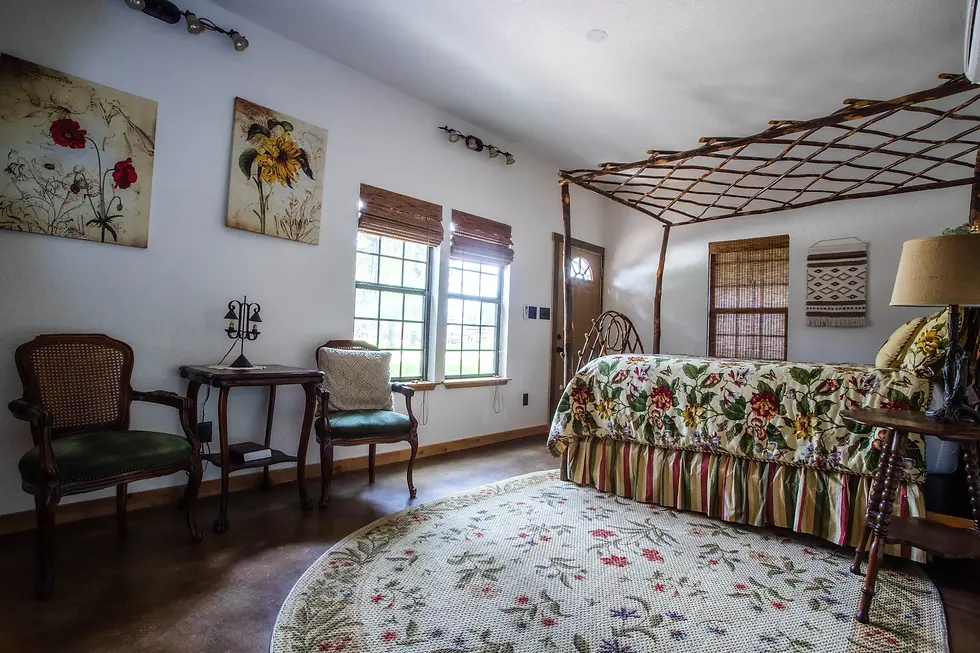
If you're weighing whether your property fits the long-term or short-term model, our accommodations portfolio shows examples of how design, location, and pricing strategy come together across different Hill Country property types, from a restored century-old cottage to a converted barn.
Data Snapshot: Fredericksburg Short-Term Rental Market in 2026
The Fredericksburg short-term rental market in 2026 shows steady but competitive growth, with supply expanding faster than demand in some months. As shown above, the market carries 3,338 active listings averaging $36,200 in annual revenue, a 39% annual occupancy rate, and a $334 average daily rate.
Metric | Fredericksburg (2026) | Source |
Active STR listings | 3,338 | AirDNA 2026 Market Report |
Average annual revenue per listing | $36,200 | AirDNA 2026 Market Report |
Annual occupancy rate | 39% | AirDNA 2026 Market Report |
Average daily rate | $334 | AirDNA 2026 Market Report |
Peak month occupancy (March) | 51% | AirROI 2026 STR Market Data |
Year-over-year supply growth | 6.9% | AirDNA 2026 Market Report |
This data matters for a specific reason: 6.9% supply growth alongside flat or slightly declining occupancy means new listings are splitting the same guest pool. A property that isn't actively priced and marketed will lose booking share to newer competitors, which is the core argument for treating pricing and listing optimization as ongoing work, not a one-time setup task.
Frequently Asked Questions
How much does it cost to hire a property manager in Fredericksburg?
Long-term residential property management in Fredericksburg typically costs 8 to 10% of monthly rent, or a flat monthly fee in some cases. Short-term rental management runs 20 to 35% of gross bookings due to the higher weekly workload of guest communication and turnover coordination.
What's the difference between co-hosting and full-service property management?
Co-hosting fills specific gaps like guest messaging and turnover coordination while the owner keeps control of pricing and platform strategy, typically for 10 to 20% of bookings. Full-service management, at 20 to 35%, hands over pricing, guest communication, maintenance coordination, and compliance entirely.
Do I need a special permit to run a short-term rental in Fredericksburg?
Yes. Fredericksburg requires a valid city business license and registration under the city's STR ordinance, renewed annually, plus display of the registration number on booking platforms. Confirm current requirements with the City of Fredericksburg, as zoning restrictions vary by neighborhood.
How do I collect and remit hotel occupancy tax on my Fredericksburg rental?
Short-term rental operators in Fredericksburg must collect Gillespie County hotel occupancy tax, currently around 8.5%, from guests and remit it according to county requirements. Rates and filing procedures are subject to change, so confirm current figures directly with the county office.
Should I optimize my Fredericksburg rental for occupancy or average daily rate?
Most owners benefit from optimizing for a blend of both rather than maximizing either alone. With Fredericksburg's 39% average annual occupancy and $334 average daily rate, pushing occupancy too aggressively with discounts can suppress revenue per available night, while overpricing during shoulder season leaves the calendar empty.
Is Fredericksburg, TX a wealthy area?
Fredericksburg is a moderately affluent Hill Country town driven heavily by tourism, wine industry revenue, and hospitality spending rather than a single dominant employer. Visitor spending generated $175 million in 2026, according to the Fredericksburg Convention and Visitor Bureau, a major contributor to the local economy alongside residential and agricultural income.
Is it worth buying a second short-term rental property in the Texas Hill Country right now?
It can be worth it if you've analyzed the specific submarket's occupancy, average daily rate, and supply growth rather than assuming the whole region performs identically. With Fredericksburg supply growing 6.9% year-over-year in 2026, new buyers should factor in more competition for guest attention than in prior years, making professional pricing and listing strategy more important at entry.
Conclusion: Making the Right Property Management Decision in 2026
Fredericksburg area rentals property management isn't a one-size-fits-all decision. Long-term residential leasing, short-term rental co-hosting, and full-service short-term management each carry different fee structures, from 8 to 10% of rent on the long-term side up to 35% of bookings for full-service STR management, and each fits a different owner situation. With the market carrying 3,338 active listings and 39% average occupancy heading into 2026, pricing precision and compliance matter more than they did even two years ago.
The owners who do best in this market treat management as an ongoing strategy, not a box to check once. Whether that means self-managing with better tools, bringing in a co-host for backup, or handing off full-service oversight, the decision should follow a clear-eyed look at your time, your distance from the property, and your revenue goals.

If self-managing your Fredericksburg or New Braunfels property is starting to feel unsustainable, or you're simply not confident your pricing is capturing what wine festival weekends and wildflower season are actually worth, Stay In The Heart of Texas can walk you through what full-service management, co-hosting, or a straightforward revenue consultation would look like for your specific property. Reach out anytime to start the conversation.
Written by Rashmi Bhat, Owner & Operator at Stay In The Heart of Texas


Comments